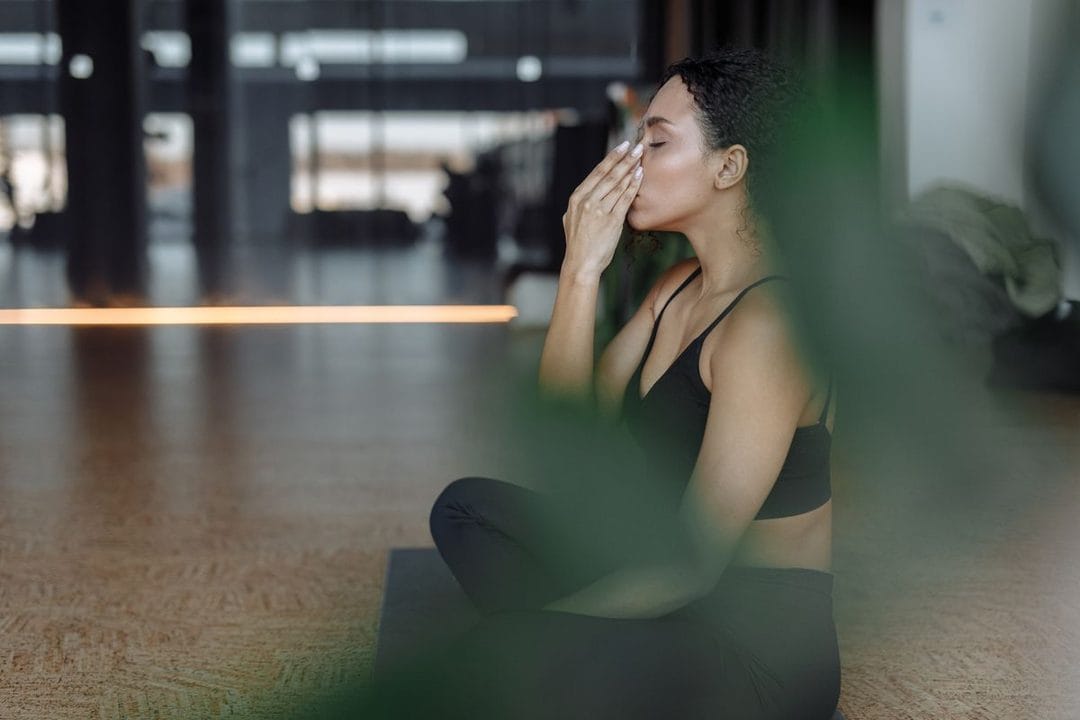
You're standing in the pharmacy line, prescription number 47 blinking on the screen above the counter, when your phone buzzes with a text from your ex about next weekend's custody swap. Your chest tightens before you've even finished reading the message. A toddler two people back is mid-meltdown, the automated coupon machine keeps chirping every few seconds, and you have maybe fifteen seconds before the pharmacist calls your number. Your jaw is doing that thing where it clenches without you noticing until it already aches. A ten-minute meditation app is not going to help you in that window, and neither is a reminder to "just breathe" — you're already breathing, that's part of the problem. What you need is something that works in about the time it takes to read this paragraph twice.
That something has a name most people have never heard outside a physiology textbook: the physiological sigh. It isn't a metaphor, and it isn't the dramatic exhale you let out after a long day at your desk. It's a specific two-part breathing pattern — two inhales through the nose followed by one long exhale through the mouth — and in 2023, a team of researchers at Stanford put it head-to-head against three other breathing methods and standard mindfulness meditation. The physiological sigh won, and not by a small margin.
What "Just Breathe" Actually Gets Wrong
When you're stressed, your breathing gets shallow and fast, and tiny air sacs in your lungs called alveoli start to collapse — not fully, but enough that gas exchange gets a little less efficient with every breath you take. Your body's built-in fix for this is a sigh: one deep breath followed by a second, bigger one that pops those collapsed alveoli back open and resets things. You already do this without noticing, on average about every five minutes, and far more often when you're anxious, upset, or trying not to cry in a meeting. The physiological sigh technique takes that automatic reflex and puts it under your control, on purpose, before your body decides you need it for you.
The Study That Changed the Advice
Researchers Melis Yilmaz Balban and Eric Neri, working in the Stanford School of Medicine lab of psychiatrist David Spiegel alongside sleep scientist Jamie Zeitzer, published their results in the journal Cell Reports Medicine in January 2023. They put 108 participants through one of four daily practices for five minutes a day, twenty-eight days straight: cyclic sighing (the physiological sigh, repeated), box breathing, cyclic hyperventilation with breath retention, or standard mindfulness meditation.
Cyclic sighing won on every measure that mattered.
Participants doing the physiological sigh reported the largest improvement in positive mood and the biggest drop in resting respiratory rate of any of the four groups — mindfulness meditation included. Resting respiratory rate matters here because it's one of the more reliable physical markers of a calmer autonomic nervous system: a slower breathing rate at rest generally tracks with a body that has shifted out of fight-or-flight and back toward its baseline. The meditation group did improve, just not as much and not as fast. The cyclic-sighing group showed measurable benefits within the first week, while the gains from meditation built more slowly over the full month.
How to Actually Do It
The mechanics are simple enough to remember under pressure, which is the entire point. You don't need to count seconds, download anything, or find a quiet corner — you need three moves, done in order.
- Inhale through your nose until your lungs feel comfortably full — this is the longer of the two inhales.
- Without exhaling, take a second, shorter inhale through your nose right on top of it, a quick "top-off" that expands your lungs a little further.
- Exhale slowly and fully through your mouth, taking roughly twice as long as the two inhales combined.
One full cycle takes about ten to fifteen seconds. Skip the advice to "take ten slow breaths" that you probably picked up in a work wellness seminar — one or two rounds of a physiological sigh does more for your nervous system in thirty seconds than five minutes of generic deep breathing, according to the respiratory-rate data from the Stanford trial. For an acute spike like the pharmacy-line scenario, one to three cycles is usually enough to feel your shoulders drop. For a daily practice aimed at lower baseline stress over time, the study protocol used five minutes.
Where This Actually Fits Into Your Week
This isn't a technique that requires a quiet room, a cushion, or an app subscription, which is exactly why it holds up in real conditions instead of just in a meditation studio. It works standing at a counter, sitting in traffic, or holding a toddler on one hip.
- Before you walk back into a meeting after your manager pulled you aside in the hallway
- Sitting in the school pickup line while the group text about the fundraiser will not stop buzzing
- Two sighs, then you open the message from your mother-in-law you've been avoiding since breakfast.
- Before a hard phone call, and honestly during one too — nobody on the other end can hear you inhale through your nose
Where the Physiological Sigh Doesn't Reach
The technique is not a treatment for panic disorder, generalized anxiety disorder, or any diagnosed mental health condition. The Stanford study specifically recruited healthy adults without those diagnoses, so the results describe everyday stress reduction, not clinical treatment. If you're dealing with panic attacks that show up without a clear trigger, or anxiety that's interfering with your job or your relationships, a physiological sigh is not a substitute for talking to a therapist or your doctor — it's a tool for the fifteen seconds before the pharmacist calls your number, not a plan for the underlying pattern.
It's also worth knowing this isn't the same practice as the elaborate breath-holding and hyperventilation methods associated with cold-exposure and breathwork trends like the Wim Hof Method. Those involve rapid over-breathing followed by long breath holds, a different physiological mechanism entirely, and they carry real risks — lightheadedness, tingling, even fainting — if done while standing, driving, or in water. The physiological sigh has none of that risk profile. It's closer to what your body already does on its own than to any performance-breathing routine.
Why the Exhale Is the Part That Matters
The two inhales get all the attention because they're the unusual part, but the exhale is doing the heavier lifting. A long, slow exhale activates your vagus nerve, the main channel connecting your brain to your heart, lungs, and gut, and stimulating it nudges your body from sympathetic "fight or flight" activation toward parasympathetic "rest and digest" mode. Your heart rate actually slows slightly as you exhale and ticks back up as you inhale — a rhythm called respiratory sinus arrhythmia — so stretching out the exhale relative to the inhale is what tips the balance toward calm. This is also, incidentally, why singers and wind-instrument players tend to have unusually good breath control under stress; they've spent years training exactly this exhale-lengthening skill without necessarily knowing why it works. If you only take one instruction from this whole piece, take this one: make the exhale slower than you think it needs to be. Most people cut it short out of habit and lose most of the benefit.
None of this requires believing that breathing can fix a bad boss, a custody dispute, or a diagnosis. What the Stanford data actually shows is narrower and more useful than that: a specific, learnable pattern that changes your respiratory rate and your mood, measurably, in less time than it takes to read a text message twice. Next time you're standing in that pharmacy line with your chest tight and the toddler still going strong two feet away, you don't need the app open or a quiet room. You need about fifteen seconds and your own two lungs.